Monday, May 4, 2020

Agenda Setting: How Media Hinders Reality

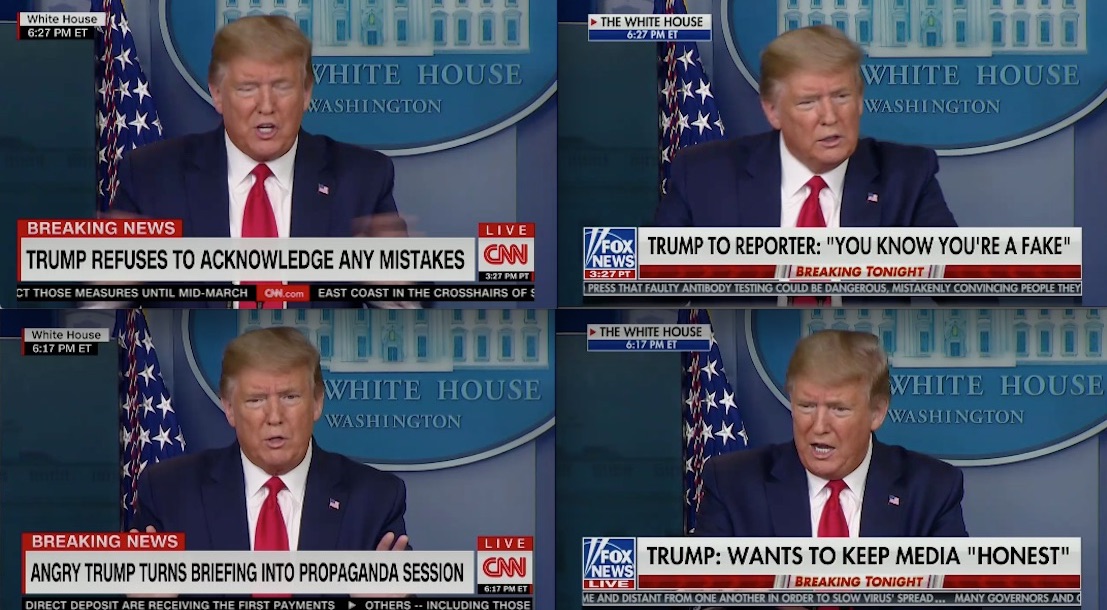
Dueling Fox News Chyrons Report on Trump's COVID-19 Briefing

Take a look above at the four images. The two on the left are from CNN with headlines that attack Trump and negatively criticize his briefing style. The two on the right are from FOX with headlines about how Trump wants to make sure that the media releases "honest" facts. All four are screenshots from the same White House press briefing during the COVID-19 pandemic but each news outlet tells a different story of what's going on. Because CNN has Democratic beliefs and values, they oppose a lot of what President Trump says and make their audience believe that Trump is not a good president at all. But FOX has Republic beliefs and values, so they often agree with a lot of what Trump says and show their audience the success of his presidency. Both CNN and FOX are the two major political news channels in the US and both compete for viewers. Because the news from the White House may not always be in their favor, they ignore some information and dramatize other key pieces to influence viewers. This is called Agenda Setting.

There is not much good about Agenda Setting as it only benefits the broadcasters. CNN and FOX care more about money, so they edit the reality to create controversy and turn your attention to them. The negatives with this is that the people aren't always getting all the correct information and their philosophies become filled with false facts. This can be an issue when it comes down to voting as voters are more influenced by the media and less by the candidates. There are many people in our country who are well informed and have strong and honest reasons about their political views, but there also many others who choose not to do the research and only pay attention to what's right in front of them. Many just read a headline without reading the entire article because they have a limited attention span, hence why social media has become a bloodbath for politics. I can barely even check Facebook without seeing someone share something politically biased.

For me, I have grown up in a Conservative household and my beliefs and values have been based off the biggest influencers in my life: my parents. However, we live in an area that is mainly Democratic, so we do our best to not bring up politics. I go on Facebook and I always see all these posts from local "friends" that rant on about how stupid Republicans are and that the whole country is falling apart because of Trump. Now, as a Republican, my family and I don't always stand with everything Trump has to say, but the media twists words and shifts attention to make my family and I look like clowns because that gets the media more followers. That being said, media outlets that are Conservative and pro-Trump do the same thing to Democrats and Liberals, which is also not right. The media doesn't use Agenda Setting because they whole-heartedly believe they should skew words. They do it because people listen to controversy and drama.

So if you want to avoid Agenda Setting and media outlets that falsify reality, do the research and search for unbiased information. Here are some websites that provide first-hand content and honest facts:


Also, here is the website for all the White House press briefings without the misleading headlines:


Police, License Plate Tracking, and the Information They Have About Us

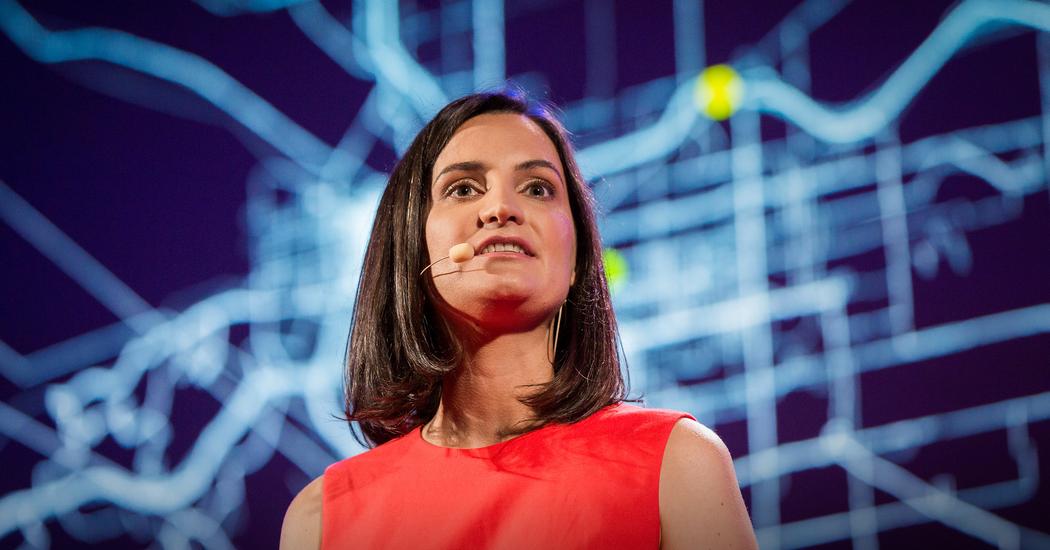
Catherine Crump: The small and surprisingly dangerous detail the ...

When it comes to government surveillance and online information storage, I am pretty split on the subject. Personally, I believe that it is not an issue for me if I don't know about it. In a TED Talk with Catherine Crump, she explains that law enforcement uses license plate tracking software to record hundreds of photos of us in our cars going throughout our daily lives. She says that this is an invasion of our private lives and this technology should not be used. While I agree with the idea, I believe that it is more threatening if the information was sold to businesses for advertising rights. For example, if a photo of my car revealed that I had a bumper sticker from a ski lodge, I would now feel violated if I began to receive ads from competing ski lodges and ski equipment sellers. The government has the right to track us as long as they are using the software for its intended use and not abusing their power. Crump explained that NYCPD officers used the license plate tracking for cars that were parked outside of inner-city mosques. While I find this to be racially profiling, I would honestly feel more comfortable if they were tracking all cars in NYC as more and more massacres are being committed by other races in the US. And besides, we don't know who could be the next serial killer or mass murderer, but having this information that may feel invasive could also be key evidence for protecting society from future deadly events.

https://www.ted.com/talks/catherine_crump_the_small_and_surprisingly_dangerous_detail_the_police_track_about_you

Thursday, April 30, 2020

How Much Do You Know About Me?

Nick Tassoni (@NickTassoni12) | Twitter

Four years ago, I posted this image of me on my Twitter account after I graduated from High School. I ended up deleting my Twitter a couple years ago, my this image remains online and is now the first image of me when I search my name on Google. Interesting.

I find myself online A LOT but I don't necessarily share too much about myself to the world wide web. I have accounts on most of your typical social media sites like Facebook, Instagram, and Snapchat, but I'm the annoying poster that shares every minute of my life. I just mainly enjoy sharing monumental moments and interesting discoveries from time to time for my friends and family.

One thing I notice is that Google doesn't really update that well on what I share, so when you search my name, a lot of the images that show up are of me playing hockey in high school, which I don't play anymore. However, there are links that are available that direct strangers to my LinkedIn and Facebook profiles. The only info they can assume about me is based on what I have shared so they may know basic info about myself but not much specifically that makes me unique. 

Sometimes I worry about the semi-shady websites that ask for my email and/or phone number because that is private information that offers direct access to me. I don't know what that website plans on doing with that info. They could say that they need it to "confirm my account" but really using that to sell my info to other companies for advertising purposes. This is the reason why my email is filled with thousands of scam messages from unknown companies. My info is vulnerable and I can't take it back.

Amazon: Buy Anything and Everything

Amazon fights poverty with Prime discount for those on food stamps

In the early 2000's, Amazon.com was a small website that served as an online retailer for independent businesses. Today, the corporation is worth over $160 billion. But how as it been so successful?

According to the Diffusion of Innovations, innovators (2.5% of consumers) were the first to discover this website and use Amazon's services. As popularity grew, so did profits as Amazon managed the trading of products and delivered packages to their buyers. Rather than searching hundreds of websites for the right product, users could just use Amazon to find what they are looking for effiencetly. Eventually, early adaptors and the early majority were able to take advantage of Amazon and get what they need fast.

Amazon's main product is their website, which continues to offer new features and services once the others begin to dry up. For example, when their original standards were reaching the late majority of consumers, it was time for a new service to introduce. Hence, Amazon Prime was created, a premium service for consumers who pay a monthly fee for reduced prices and free shipping. This started the theory all over again as the innovators who stay updated on Amazon's trends were the first to complete their membership. 

The theory becomes a cycle for a company like this as one idea begins to vanish from a society, a new innovation is invented to make them relevant again.


Individual Self-Fulfillment

7 Steps to Self-Fulfillment | Brian Tracy

Of the Eight Values of Free Expression, I believe that Individual Self-Fulfillment is the most important. Also known as "Self-Actualization", it is our will power that drives us to be better and write our own story in history. Without this quality, it can be difficult to accomplish the other 7 values of Free Expression.

The most important person in your life is you and it is your ultimate job to care for yourself. According to Maslow's Hierarchy of Needs, we humans have a top priority of accessing physiological needs like food, water, sleep, and oxygen. After that, the next set of important needs concerns our safety and security from threats. These first two sets are considered the basics for human life but are also the minimum requirement.

On the third rung of Maslow's Hierarchy of Needs, human beings require love and a sense of belonging. Family and friends grow as a community to strengthen and motivate one another, and a life partner can be there for you to offer comfort and trust. The next set is about the need for positive feelings like self-esteem and self-respect. Learning to have control of yourself and enjoy life can relieve dangerous mental pressure.

And at the bottom of the pyramid lies creative self-growth and the feeling of reaching your potential. This concerns your career and hobbies that you take part in to grow your mindset and contribute to the world. What you do and accomplish adds to your experience and makes you stronger everyday.

This is why Self-Actualization is so important because you need to have your needs in order before you can attend others' needs. You are the top priority and your health and safety is crucial for you to be able to love, motivate, and inspire.

How Facebook Changed Social Interaction

Is Facebook Making Us Lonely? - The Atlantic

In 2004, four Harvard graduates created the first social media platform for people to communicate through messages and media on the internet. Facebook is an online hub where users can follow their friends and be constantly updated on their lives. It is an opportunity for many to share their stories and gain attention. However, although Facebook has kept society more connected, they have also help change the way we interact and communicate.

It is almost impossible today to stand in a crowd of people and not find someone on social media. This innovation of technology gives us an inside look of what others are experiencing and the news and trends we should be aware of. This key information limits our vocal social skills as we don't need to ask others in person. Initiating random conversations with strangers is rare nowadays because we can access social media and easily find one. We have the option to be anonymous and speak freely without damaging your name. We can do silly and crazy things just for "likes" but be emotionally hurt when we receive "dislikes". Meanwhile, public gatherings feel quiet as people feel more comfortable in their virtual worlds.

Facebook created a social media revolution that has changed all of us. Where do we go from here? Social media grows larger in size everyday and there's no way of stopping it anymore. Will our voices stay silent as our fingers text what we have to say? Public speaking, which was once a common trait, is now considered a "gift" and takes time to practice. 


Google: The Face of the Internet

Google co-founders Larry Page and Sergey Brin: a timeline of their ...

In 1998, during the beginning of the internet, two Stanford graduates named Larry Page and Sergey Brin created a website that organized online data for users to easily find and access information. Named Google, this search engine has now evolved and become the internet. The multi-billion dollar company is able to control what we see on the internet and can influence what we do.

Since their creation, the famous tech company has done more than provide search options for the internet. Some of their most popular innovations include:

Google Maps: GPS software for smartphone and computer that helps map out locations for easier travel
Youtube: Social media platform for video-sharing
Gmail: Email platform, most popular in US
Google Drive: Document-sharing website for storing files and collaborating with other users
Google Translate: Can easily translate any text into any official language

Google today is still the leading competitor in the tech industry and is staffed by some of the smartest young beings in the country.

https://about.google/


The Good, The Bad, and The Ugly of Technology

I remember on my 13th birthday when my parents allowed me to have my own Facebook account. I was so excited because I could connect wit...